
GIF from giphy.com
Note Before Reading: The pictures used in this blog were made by me through Microsoft Publisher. I hope they help depict and get my point across 🙂 Enjoy!
How constructivist am I?
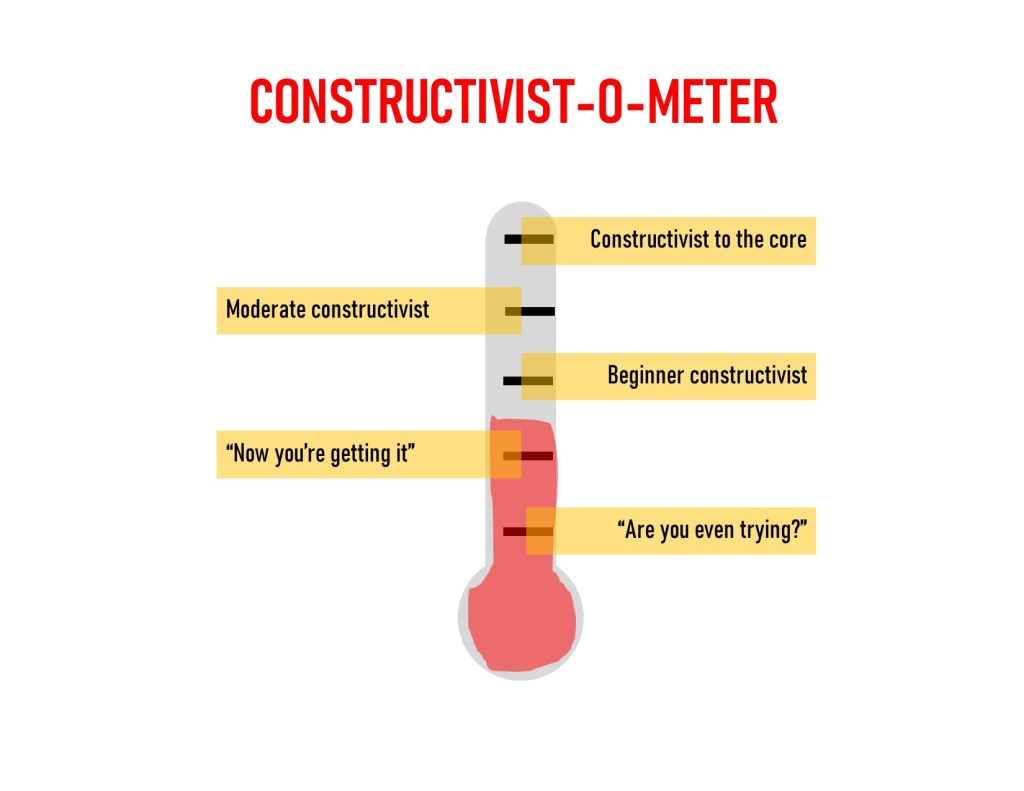
Not much so far, but I absolutely want to be
(Made in Microsoft Publisher)
I want to be a moderate constructivist, but not a constructivist to the core. I believe that too much of being a constructivist will cause a person to abandon the traditional educational system and practices which is not good in terms of schooling. Schools are there to help students acquire education for a better future despite theories and criticism that says otherwise (Bautista, M.C.B., Bernardo, A.B.I. & Ocampo, D., 2010). However, even if schools and institutions (i.e. educational system) have good intentions, there are some instances that their aims cannot be met. Hence, being a constructivist learner and its benefits can help be a model for others (like classmates and teachers) to try out too.
How can I become a better constructivist?
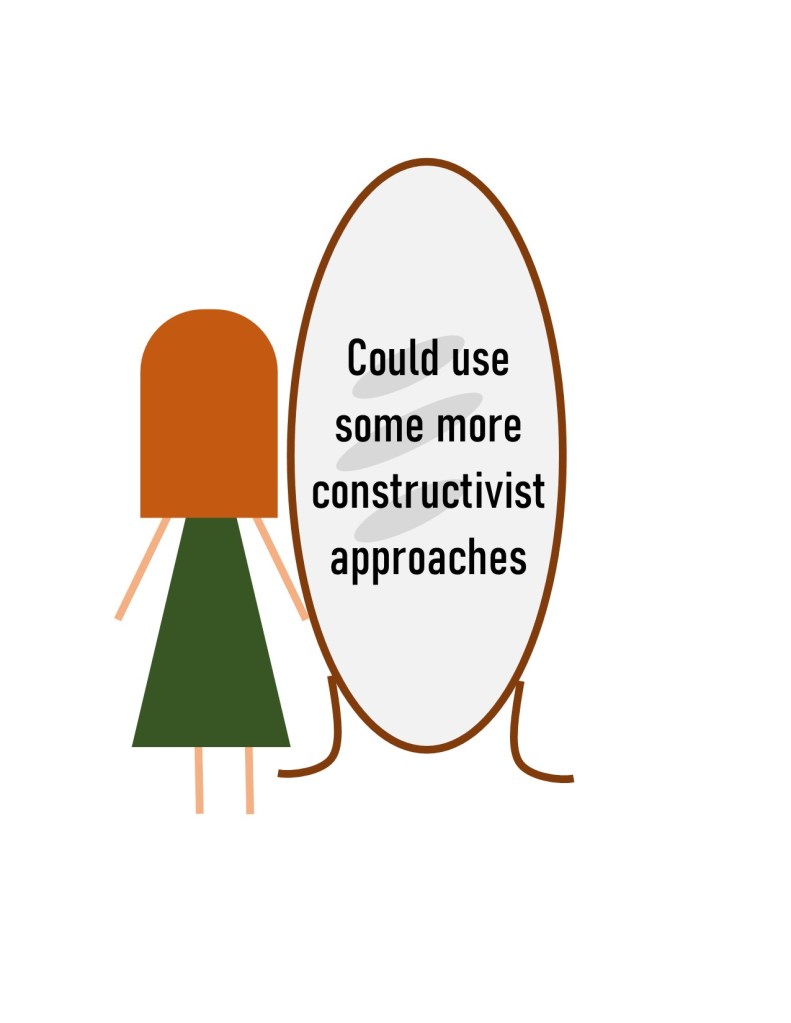
Evaluate myself, then start improving from there
(Made in Microsoft Publisher)
Right now, I think that I was not constructivist enough. I was and sort of am stuck in the “reinforced by good grades” phase rather than learning through constructivist approaches. But now that I know the major differences in term of which is better for building schema through reflection and application of past learnings and new learnings, I will be more encouraged and motivated to take on constructivist approaches from now on. Sort of like renewing a lifestyle.
How may I influence education practice to shift towards constructivist pedagogy and practice?
Start with me, then others
I want to be the role model. Just like in praxis, I first must be knowledgeable of the problems of other learning behaviors that are not centered towards a constructivist pedagogy and try to come up with ways that this may be resolved- practicing constructivist learning and teaching. Of course, though, if there are no possible or observable ways to resolve the issue, I will just enforce constructivist approaches and practices to be the change I want to see in others while making sure that the peple in my environment are aware of my perceptions and concerns on the issue of the lack of true learning through the building of schema through experiences.
Do you have personal anecdotes to describe other benefits that might be experienced from learning in cooperative groups?
Evaluation of student competency
There was this part in the module that really got me thinking of the other benefits of groupings aside from motivation to learn with others and through others while being dependent on individual learning. Another benefit of cooperative groups that I experienced is that it serves as an evaluation of student competency to not only contribute to the group, but to be a team player. This information will be helpful for students to be aware of what approaches to take to motivate that student when he is in the group and for teachers to be knowledgeable of the students’ competencies that need improvement to properly place them in equal group and to create activities that will help them improve.
To what extent have you intentionally engaged in discussions with your peers to learn your lessons (rather than comply with the tasks) in the course?
I’m afraid not much, but now I know better
Unfortunately, I did notice that some of my discussion posts and replies were stated a bit a matter-of-factly while only a few were discussion worthy. I guess I was too focused on the tick marks and deadlines that I forgot to put my learning ahead of any merit reinforcement. All I can say is, “Now I know” and hopefully, you do too 🙂
This Blogs’ Takeaways:
- (Individual) Evaluate how constructivist you are to improve from there on.
- (Environment) Start with yourself before trying to improve your surroundings or others.
- (Classroom) Use cooperative learning for student (self and teamwork) competency evaluation.
- (Individual) Learn through a constructivist approach with this idea in mind to learn with a purpose: “Learn not to know more, but to ignore less” (Sor Juana Ines de la Cruz from TED-Ed, 2019).
References:
Bautista, M.C.B., Bernardo, A.B.I., & Ocampo, D. (2010). When reforms don’t transform: Reflections on institutional reforms in the Department of Education. Human Development Network. Retrieved from https://pdfs.semanticscholar.org/0a40/4ae4f8ab16ecc5903c637c3528699afe2aab.pdf.
TED-Ed [Theresa A. Yugar]. (November 21, 2019). History’s “worst” nun – Theresa A. Yugar. Retrieved from https://www.youtube.com/watch?v=9wSOt3z_-YY.
Comments and Inquiries
Any comments are very much appreciated! Click the Leave Comment button in the bottom of each blog to open the link (to myportal eJournal Forum Post reply) to leave your comment.
 "Aha!" Instances